Reading
Understanding text and information


MIT OPEN LEARNING · UNIVERSAL AI
Not a course that teaches students to write code — a course that teaches them to understand, use, apply and evaluate AI.
An online general-education program built by MIT faculty and experts, teaching AI through real cases with no coding or advanced mathematics required. Open from age 14. Complete a module and pass its assessment to earn a certificate issued by MIT Open Learning, verifiable online.
 · Authorized Promotion and Enrollment Center
20+
modules
An introductory module, 16 foundational modules and a growing catalog of domain-specific verticals; each module 2–5 hours, self-paced online
0
coding
No coding or advanced mathematics required; suits arts and science students alike
14+
age
Open to learners aged 14 and above; parental consent under 18. The platform is in English, with simplified Chinese translations provided by MIT Open Learning
2
types of certificate
A Module Certificate for each module completed; a Program Certificate on completing all foundational modules — both issued by MIT Open Learning, verifiable online
01 · WHY NOW
After reading, writing and arithmetic, the ability to use AI has become the fourth basic literacy — the IMF estimates that about 40% of jobs worldwide are exposed to AI.
Understanding text and information
Expressing views and ideas
Quantitative analysis and reasoning
Understanding, using and directing intelligence
WHY FROM AGE 14
At this age students enter the stage of abstract and systems thinking: they can grasp concepts, ethics and causality rather than only operate tools. Building sound habits and judgment before AI becomes everyday is far easier than catching up later.
WHY NOW
Generative AI is already in the classroom; the only difference is whether students are used by the tool or know how to use it. Using and understanding AI is becoming as basic as reading, writing and arithmetic.
WHY NOT A CRASH COURSE
Coding boot camps equate AI with programming and shut out arts and business students; fragmented online courses have no structure; trend-chasing tool courses go stale the moment the tool changes. A good AI general-education course needs a trustworthy origin.
02 · WHO BUILT THE COURSE
MIT Open Learning is the Massachusetts Institute of Technology's online learning unit for learners worldwide; Universal AI is developed by it and delivered on the MIT Learn platform.
No coding or advanced mathematics required; students heading for the arts, business or social sciences fit equally well. Teaching is narrative-based and grounded in real cases rather than mathematical models and derivations.
Domain-specific vertical modules apply AI to healthcare, transportation, sustainability, entrepreneurship, finance and ethical decision-making — teaching a method for solving problems, not a tool that will go out of date.
Explainability, fairness and ethics are part of the foundational modules, not an appendix. Students learn not only to get AI to do things, but to judge whether it did them right.

03 · WHAT YOU RECEIVE
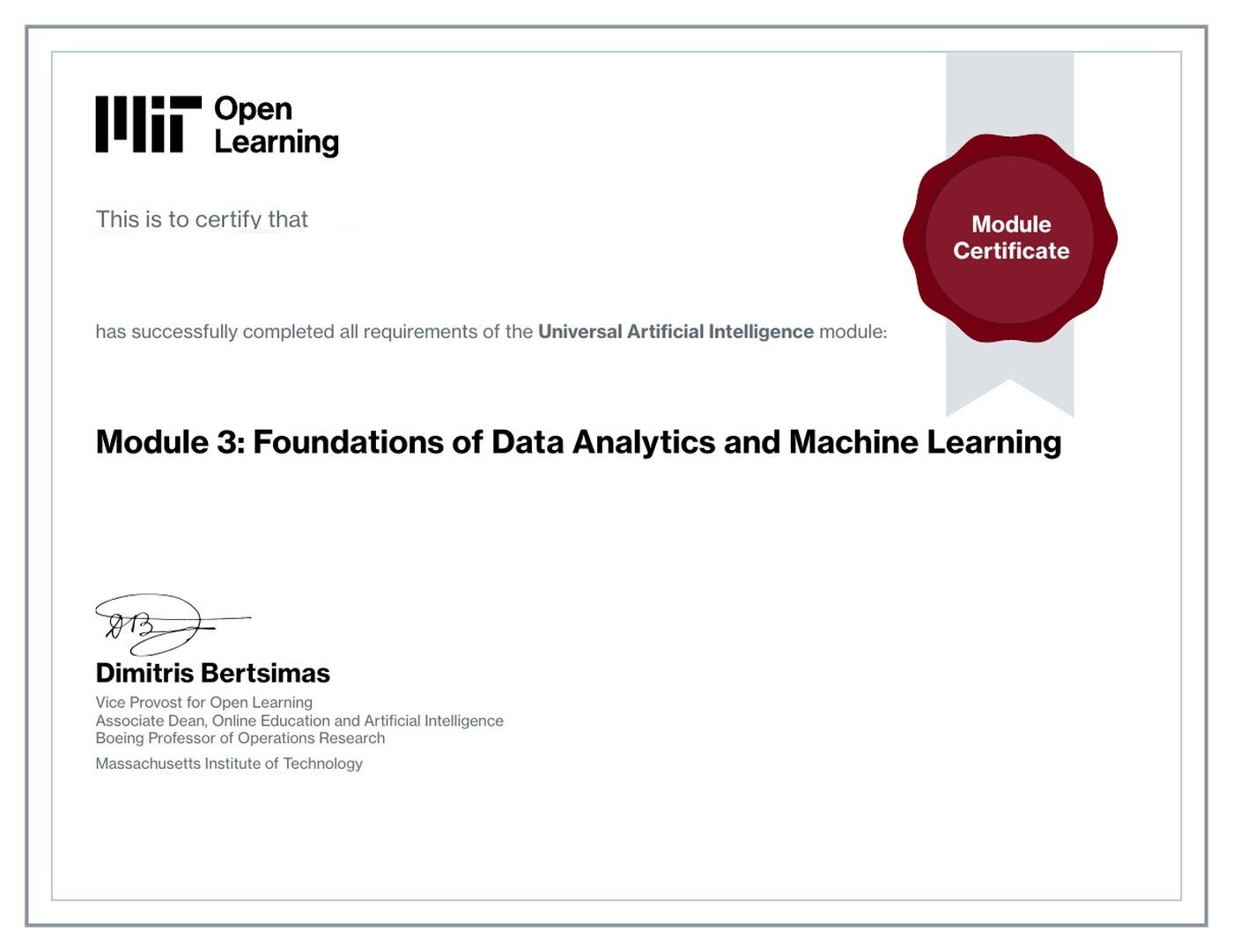
Each module completed and assessed to MIT Open Learning's standard earns a digital certificate issued by MIT Open Learning, with a unique ID and online verification. Module certificates are stackable: complete all the foundational modules and you earn the Program Certificate.
1
Awarded for completing any foundational or domain-specific vertical module and passing its assessment.
2
Awarded on completing all of the foundational modules — the complete record of achievement in Universal AI.
Certificates are issued exclusively by MIT Open Learning, which determines whether the standard has been met. A certificate attests to learning outcomes; it does not confer credit, a degree or a license, nor MIT student status; credit recognition is decided by the student's own institution. Certificates must be earned within the 12-month subscription period.
04 · WHAT YOU LEARN
Not centered on mathematics and coding: a complete AI literacy is built around four capabilities, driven by real cases.
01 · UNDERSTAND
How AI works, what it can do, where its limits are.
Start with M1, an introduction to how AI works and where it is used. M2–M8 then build your skills in Python, data analytics, machine learning, supervised and unsupervised learning, neural networks, deep learning, and computer vision. No coding background is assumed: Python is taught from scratch in M2–M3, and each module builds on the last.
02 · USE
Turn generative AI and large models into everyday, capable tools.
M12–M15 explore the AI tools people use today: large language models and prompt engineering; generative AI, the future of work, and human creativity; text-to-image diffusion models and multimodal AI; and LLM-based agents and retrieval-augmented generation (RAG). Practice on MIT Learn, with AskTIM on hand to answer questions.
03 · APPLY
Use AI on concrete problems in real industry settings.
M9–M11 move from prediction to decision-making through prescriptive AI, including policy trees, linear and integer optimization, and network flows. After the foundations, V1–V8 apply AI to energy, transportation, precision medicine, medicine, entrepreneurship, and finance—from forecasting demand to exploring 12 real clinical cases.
04 · EVALUATE
Critically evaluate AI outputs, risks and ethics.
Explainability, fairness, and ethics are part of the foundations, not an appendix. M16 covers explainable AI and fairness; M17 examines ethics, bias, and AI alignment. V8 develops ethical reasoning in AI-assisted decisions, including values, trade-offs, accountability, and responsible use. Learn to judge whether AI is doing the right thing.
05 · THE MODULES
Universal AI is a single linear program. It opens with an introductory module, continues through 16 foundational modules in order, and then offers domain-specific vertical modules that apply AI to an industry. Every module is self-paced on MIT Learn, with lectures, knowledge checks, guided exercises and auto-graded assignments; each completed module earns its own certificate. Module titles follow the MIT Open Learning Universal AI curriculum.
Carries a Module Certificate; not counted among the 16 foundational modules.
Completing all 16 earns the Program Certificate.
Part of Universal AI, taken after the foundations. New verticals are added to the catalog regularly.
06 · APPLY7 SCHOOL PARTNERSHIPS
Run the program under your school's name. Purchase accounts for at least 10 learners and launch in 1–2 weeks. Contact an advisor for pricing.
Student-led learning
The subscription runs 12 months from activation on MIT Learn, and certificates must be earned within it. Once activated it cannot be cancelled. Includes a half-day teacher training session before launch and remote support from an Apply7 advisor.
Recommended · Live Q&A
Everything in Self-Paced, plus one 90-minute live online Q&A session each month. Students from different classes can join together. Ideal for schools that prefer to have course questions answered by an instructor.
Live instructor-led classes
Everything in Guided Learning, plus live classes taught by an Apply7 instructor, with a school teacher serving as class coordinator. Designed for schools offering the program as a formal school-based course.
Accounts are purchased under the school's name for use by its own students only, with a minimum of 10 accounts. Teacher training, advisor support, live Q&A, and instructor-led classes are services provided independently by Apply7. They are not part of Universal AI and do not change its course content, assessments, or certificates.
Schedules and class formats vary across international schools, high schools, vocational schools, colleges, universities, and training providers. During the demo, we'll prepare a one-page plan for your school.
 AUTHORIZED PROMOTION AND ENROLLMENT CENTER · CHINA
To enroll in Universal AI from China, contact Apply7. Apply7 handles program information, purchase of the subscription, acceptance of the course terms (age-14 verification and parental consent for minors) and the dedicated link through which each learner registers their own account on MIT Learn. Everything the learner then receives — content, AskTIM, assessments and certificates — comes from MIT Open Learning on MIT Learn, as described above.
Scan to reach an Apply7 advisor on WeChat.
Questions about enrolling? Email alice.wang@apply7.ai
Replies on weekdays, 9 AM–9 PM.
Yes. No coding or advanced mathematics is required to start; the course enters through AI concepts, real problems and industry applications, and suits arts and business students equally. Python is taught within the sequence (M2–M3) for those who want it.
Registration from age 14; parental consent under 18; no learner under 14. Platform and content are in English, and MIT Open Learning also provides simplified Chinese translations.
Each module is about 2–5 hours of self-paced study. The 16 foundational modules take about 57 hours in total (an Apply7 estimate; the platform is authoritative). Learners study at their own pace within the 12-month subscription.
MIT Open Learning issues it against the completion standard, with a unique ID and online verification. There are two types: a Module Certificate for each foundational or domain-specific vertical module completed, and a Program Certificate on completing all the foundational modules. It attests to AI learning outcomes; it does not confer credit or a degree, does not represent MIT student status, and is not a guarantee of admission.
The subscription runs 12 months from activation on MIT Learn, and certificates must be earned within it. Once activated it cannot be cancelled.
The AskTIM AI assistant is built into the platform. Platform and content questions go to MIT Open Learning's email helpdesk (in English; response within 3 business days).
Apply7 is an Authorized Promotion and Enrollment Center for Universal AI in China, appointed by MIT Open Learning. Course content, platform and certificates are provided by MIT Open Learning; enrollment and registration in China are handled by Apply7.
No laboratory or special equipment is needed — an ordinary computer suffices.
No. The program is self-paced and asynchronous, delivered entirely on the MIT Learn platform, with auto-graded knowledge checks, guided exercises and assignments. School teachers organize learning and provide judgment and oversight. Apply7 provides a half-day training session before the course begins.
Pricing is per account, with a minimum purchase of 10 accounts. Rates vary by plan. Contact an advisor for a quote.
Universal AI is a program of MIT Open Learning, delivered on the MIT Learn platform. Apply7 is an independent company and the Authorized Promotion and Enrollment Center for Universal AI in China. Universal AI does not confer a degree or license and carries no credit; credit recognition is decided by the learner's own institution. Hour estimates on this page are Apply7's; the platform is authoritative.
© 2026 Apply7 · 上海趣申请科技有限公司 · Universal AI is a program of MIT Open Learning; Apply7 is an Authorized Promotion and Enrollment Center for Universal AI in China, appointed by MIT Open Learning.