
Act I
Meet the Hero
Who they are now: grades mentioned only once, three strengths, four gaps.
Educational planning isn't a college list. It's the blueprint for building your child a school of their own: five steps, with someone responsible for every next one.

Step 1
Assess · Understand Your Child
We look at your child across five areas: academics, personality, soft skills, the parent–child relationship, and inner drive. You and your child each complete an assessment, and you receive a clear, easy-to-read profile of your child.


Co-designed by Dr. Pengkai Pan and Dr. Huang. Every question is grounded in developmental psychology, and the results describe your child's style without putting a label on them.
Step 2
Plan · Decide the Path Together
A PhD mentor reviews the assessment, grades, and activities and discusses them with your child and you, producing a planning report with a source for every recommendation.

How the Plan Gets Made
Your child does the talking; you fill in the details without deciding for them. That kind of trust is the most important foundation of any plan, more than any single course.
Act I
Who they are now: grades mentioned only once, three strengths, four gaps.
Act II
Possible directions, a north star to look up to, five things to keep and five to cut, and a map of majors and careers.
Act III
Mentor, advisor, parents, and student: who is responsible for what.
Act IV
The two most urgent foundations, building a signature strength, the path year by year, and reference schools.
Act V
Over the next 30 days, each of the three of you does three things.
Case Study · Student Wang · Anonymized Sample
A business mind, math ahead of grade level, ten years of public speaking, but no signature strength yet. The planning report makes every one of his next four years count.
01 · Today
A ninth grader at a U.S. high school: straight As, already in Precalculus, multiple first places in school speech contests, and one bad grade he turned around himself. Good grades, sports, and a good personality make him "not bad," but that's not yet a signature strength.
02 · Possibilities
Start with the family's retail business and use math and data to understand how money moves. His north star: Ray Dalio, who caddied at 12 and bought his first stock with the tips. Three possibilities run in parallel; nothing is locked in.
03 · Actions
Keep: advanced math, taking speaking beyond school, a small study of the family business, one sport pursued to a competitive level, and a rock-solid foundation. Cut: résumé-padding activities, chasing test scores in ninth grade, three sports at once, certificate-only summer programs, and locking in a major.
04 · Goals
At a family planning meeting at the end of the summer after tenth grade, three pieces of evidence will narrow the direction: how far his math has gone, whether the business study produced results, and whether his speaking has gone beyond school. Stanford and Wharton are long-term goals he'll have to earn with evidence.
05 · How Parents Can Help
Confirm courses, his main sport, residency status, and budget. Give him access and permission to research the store. Hold the line on the five things to cut, without second-guessing extra classes. And keep the relaxed family atmosphere you have now: it's the hardest resource in any plan to buy.
From who your child is today to what each of you will do in the next 30 days. Sample anonymized.
Step 3
Monthly · Turn the Plan into Monthly Steps
The plan is broken down by week, month, semester, and year. Mentors guide your child forward, and you see the progress along the way.
Your child and their support mentor work through one sticking point or one emotional moment, and check whether one small step got done.
The lead mentor, you, and your child go over what got done this month, where things got stuck, and three priorities for next month, and check progress on the five things to keep.
Review grades, course choices, and activity levels to see whether all three priorities are actually moving.
Use verifiable evidence to narrow the direction. If it's time to switch, switch. That isn't failure; it's what key milestones are for.
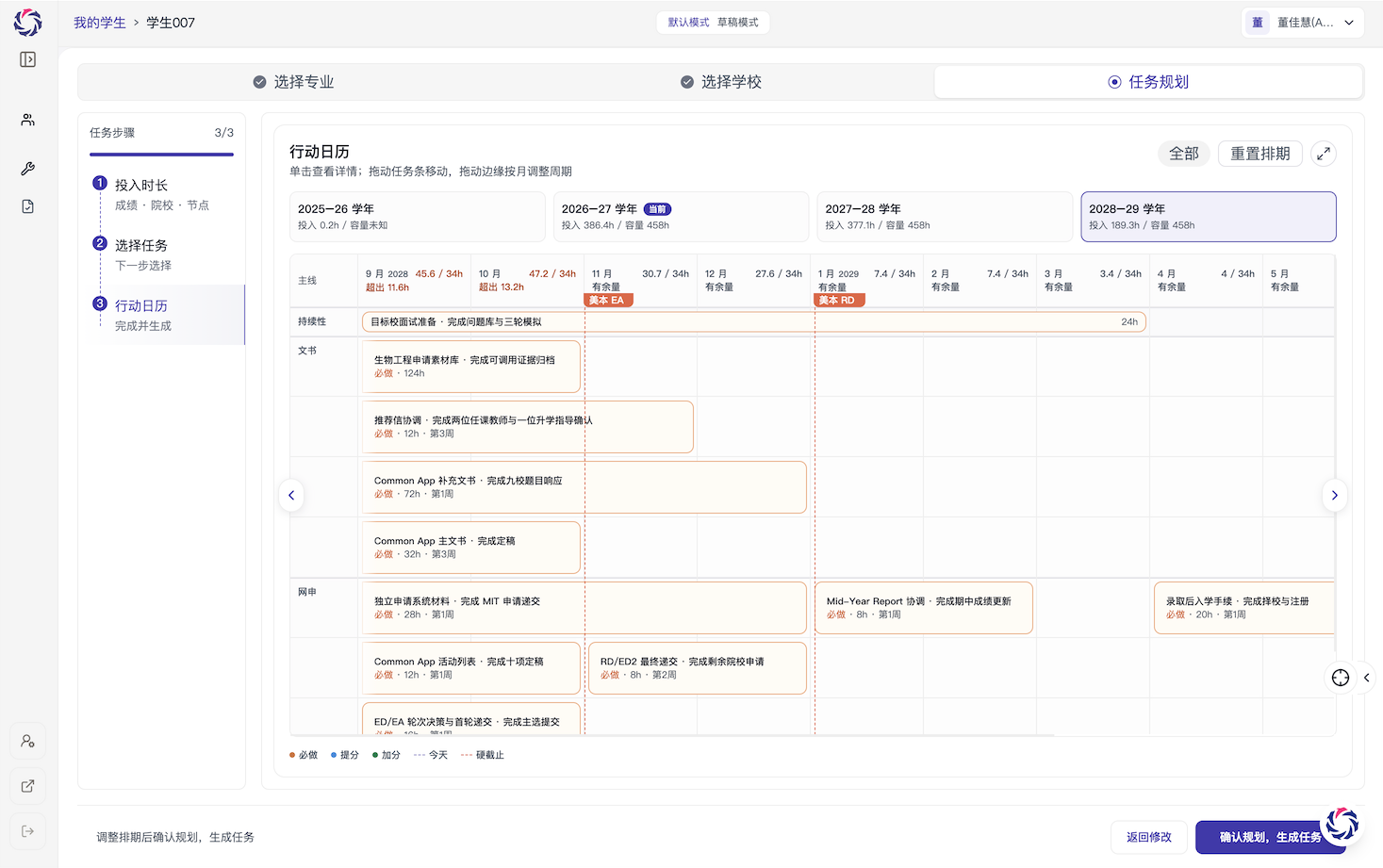
Your child's support mentor checks in weekly, keeps a record of changes, and flags key deadlines. Each month you'll receive a progress report: what got done, why some things didn't, and how to catch up next month. Key decisions are made by the PhD mentor together with your family.
See Monthly ReportsIn one call, we'll help you decide whether your child needs an assessment, a course, or a long-term mentor.
Scan to Add Us on WeChatReplies weekdays, 9 AM–9 PM Mention "Website" when adding